Author: Ethan Perry

When we arrived in the office in the city maintenance building Tuesday evening, small, freshly cut tree branches were strewn across the meeting table. Each was numbered on a piece of masking tape. Clark Christenson, Duluth city forester, was instructor for our first event of the year. Tree enthusiasts came out of the woodwork to learn about winter twig identification.
Clark led us through the twig key in the book Fruit and Twig Key to Trees and Shrubs by William Harlow, leaving fruit identification for another day. He also provided a 2-page key produced by the University of Wisconsin at Stevens Point that covers just the native trees of our region: https://www.uwsp.edu/wp-content/uploads/2023/11/leaf-winter-tree-id-key.pdf
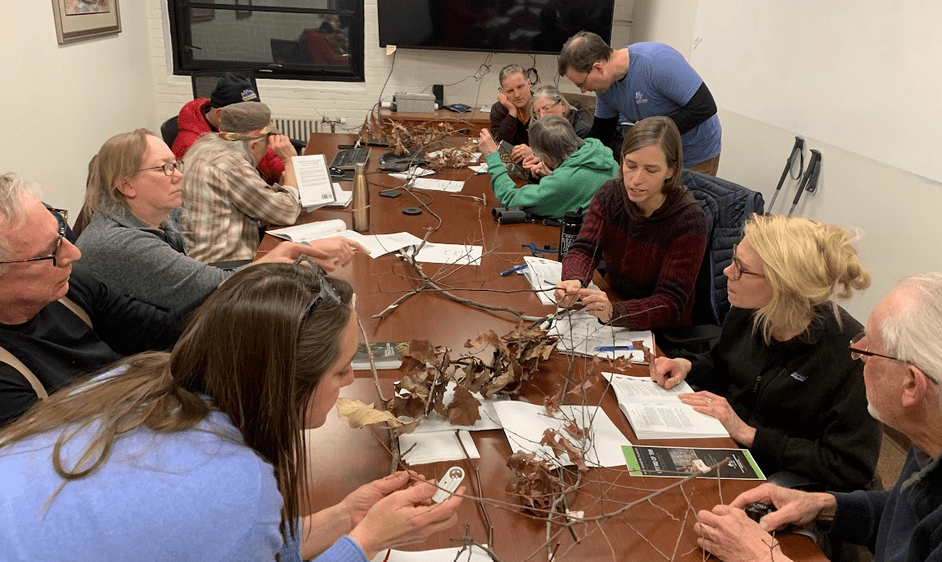
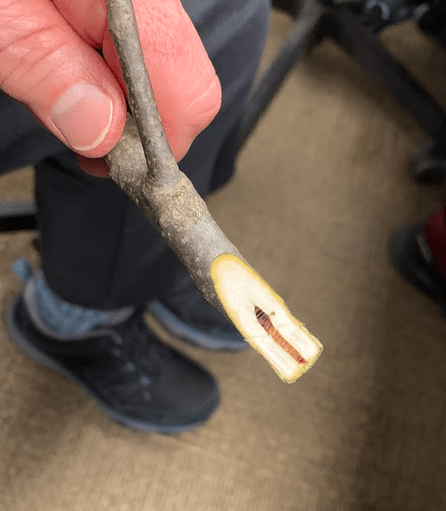
Clark started with a review of the features we can use to identify deciduous woody plants without their leaves or fruits. These include the buds, bark, pith, twig configuration, and even smell. The first step in the key is to choose between opposite-leaved and alternate-leaved species, which is usually obvious in the branch configuration and bud placement. The buds take more careful study. Some have obvious scales; some don’t. Some twigs don’t have terminal buds. Below the buds are leaf scars (where the leaf used to be attached), and in the leaf scars there may be vascular bundle scars of various numbers, shapes, and configurations. The pith, the softer center of the twigs, varies in color and consistency.

As a group we tackled several of the branches on the table. To increase the challenge Clark selected species we might not be familiar with and which led us into different parts of the key. Many of us were surprised to learn of Ohio Buckeye, Butternut, Kentucky Coffee Tree, and Yellow Wood growing in Duluth. By testing these native North American trees in Duluth, the city can increase its tree diversity and its resilience to future pests and diseases.
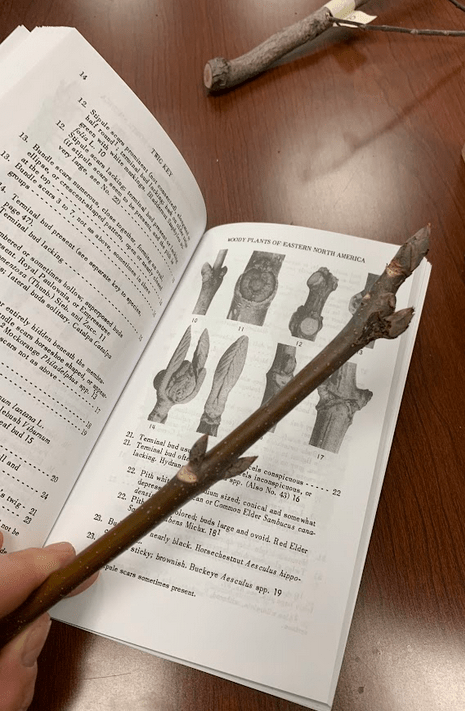
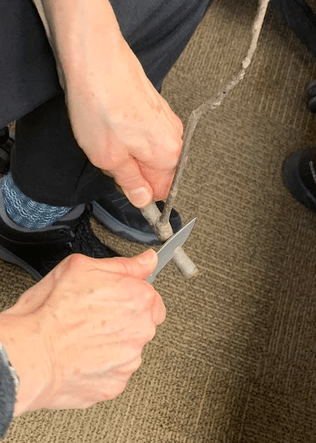
Several times as we worked through the key, we came to a species we knew was incorrect or a decision where neither option fit the branch we were looking at. Then we skipped back to earlier decisions we’d been unsure of and followed the key to a new conclusion. These mistakes are an inevitable part of using a botanical key, and they actually boosted our confidence in identifying trees and shrubs in winter.
For additional tree identification information, see links below!
City of Duluth Street and Park Tree Inventory
University of Wisconsin – Stevens Point winter tree and bud ID sheets
 Arrowhead Native Plant Explorers