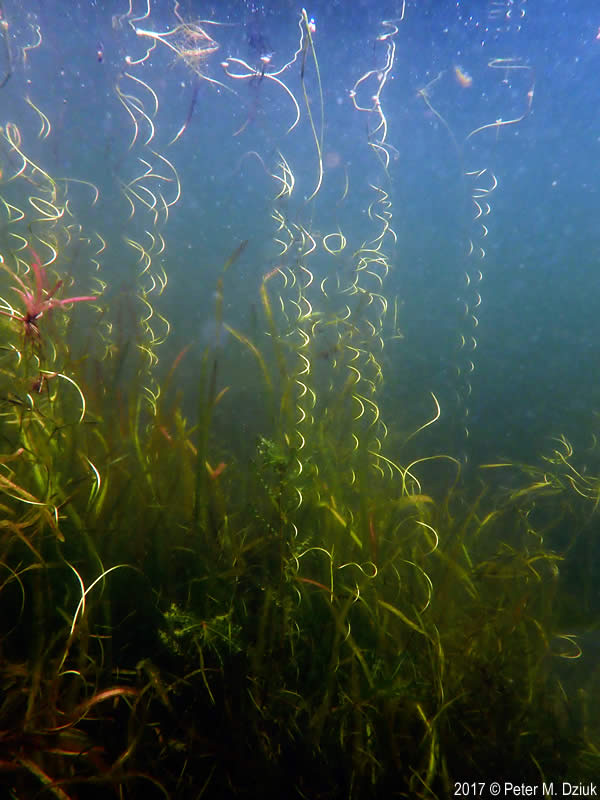
Wild Celery, American Eelgrass, Tapegrass
Paddle through the waters of MN and WI lakes and streams and you will likely spy Vallisneria americana. Its ribbon-like leaves and curious spiraling reproductive stalk are sure to draw your attention.
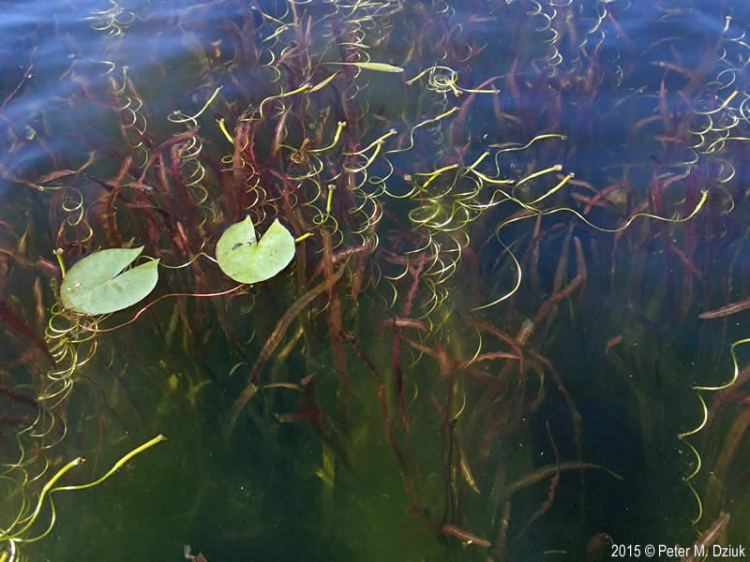
Its green to reddish leaves grow within a basal cluster, fully underwater or are sometimes floating or flowing. The leaves have a noticeable stripe in the center and slightly serrated edges. Vallisneria americana most often spreads vegetatively in a horizontal method via stolons or rhizomes. However, it also has a visually captivating, though not necessarily reliable method of reproduction via pollination.
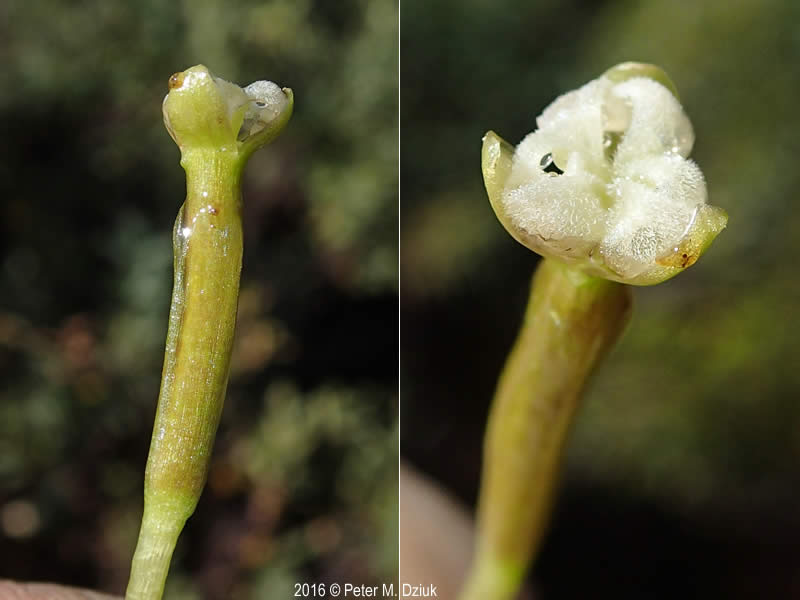
The male and female flowers are produced underwater on separate plants. The white female flowers are sent upwards through the water column at the head of a corkscrew-like stalk and bob just at the surface. Meanwhile the male flowers develop in a “floral envelope” that includes an air bubble, which allows them to float to the surface when released. Upon reaching the surface, the floral envelope opens and creates a sail that helps it move across the surface of the water. If by chance, the male flower gets close to the female flower, it is drawn in with surface tension and pollinates the female flower. After fertilization, the female flower retracts back down below the surface and a long , 2-4” bean-like fruit, full of seeds develops.

Vallisneria americana is the preferred food (foliage, rhizomes, tubers, and fruit) for canvasback ducks (Aythya valisneria) as well as numerous other marsh and shoreline bird species. Canvasbacks are known to change their course of migration to access this food source.
For more information about this amazing plant visit Minnesota Wildflowers or check out Through the Looking Glass: A Field Guide to Aquatic Plants by Susan Borman (Author), Robert Korth (Author), Jo Temte (Author), Carol Watkins (Illustrator)
Information about this plant was summarized from the sources above. Photos by Peter Dziuk.
 Arrowhead Native Plant Explorers