Writing and photos by: Susan Nygaard

On Saturday, June 14, the Orchid Special Interest Group (O-SIG) of the Arrowhead Native Plant Explorers (ANPE) held its first field trip, a hike through various spots within the Boulder Lake Management Area (BLMA) near Island Lake. Though the forecast was initially somewhat foreboding, the weather turned out to be perfect for the thirteen eager participants, one of whom drove up from the Twin Cities area that morning specifically for this event. The hike was led by Rubin Stenseng with assistance from Susan Nygaard. Rubin’s long history of volunteer work at BLMA has given him a great deal of insight into the variety of native orchids that flourish here, and we saw a total of eight different kinds of orchids, though not all were currently blooming, of course.
After all the registered participants arrived, Rubin gave a brief introduction to the BLMA, and we all introduced ourselves. Rubin also had some helpful handouts for everyone, a list of the Native Orchids of Minnesota and a Phenology chart with blooming times. We then carpooled to five different sites within the MA, with some of the stops involving short hikes along ski or hiking trails. The various spots included different habitats, from conifer swamps to pine barrens.
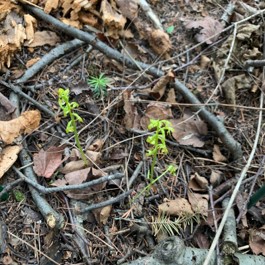
The first two orchids we considered were Yellow Lady’s-slippers and Early Coralroot, the first being a common sighting and the latter much more unusual. We discussed what makes an orchid an orchid, and what–if anything, considering its tendency to hybridize–definitively distinguishes the large from the small yellow slippers. That led to questions about how orchids trick their pollinators into serving their needs. When we viewed the tiny Early Coralroot specimens Rubin had protected with cages, conversation moved into the fascinating topic of symbiotic and parasitic relationships between orchids and their fungal partners. Geromine’s research into this topic added much valuable insight! These discussion topics continued as we moved to other sites and other orchids.

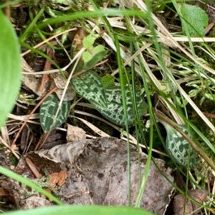
We observed a great many blooming Pink Lady’s-slippers in a few locations, including both wetland and pine barrens habitats. Discussion ensued about the species’ adaptability, and the earlier conversation about pollination continued, as the mechanics of the process are more visible with the Pink slipper. Seedpods from the previous year’s blooms were highly visible and Rubin talked about how one can often locate an orchid by searching for its seedpods. In the same area, we observed the small leaves of the Tessellated Rattlesnake-plantain and the seedpods of both Slender Ladies’-tresses and Green Adder’s-mouth. While not endangered, these three are not orchids one sees everywhere!
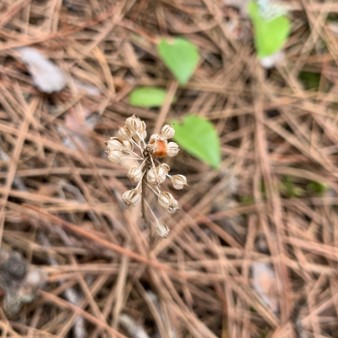
In two different wetland areas, we found the even more miniscule leaves of the Lesser Rattlesnake-plantain, and a specimen of the Bluntleaved Rein orchid–spotted by a first-time ANPE participant! Again, these are not found just anywhere; clearly BLMA is a special place. Throughout the event, folks were taking photos of various other wildflowers, chief among them the tiny and alien-looking Naked Mitrewort and the more common Twinflower, Starflower, and Canada Mayflower.
There were many fruitful and friendly side conversations along the way, and both Rubin and Susan were kept on their toes by the many probing and intelligent questions posed by the group members. In fact, there was so much interest and discussion that we ran out of time in our allotted three hours and had to skip a couple stops on the original itinerary–a testament to how fascinated folks were by every aspect of our native orchids. Considering that the Arrowhead is a hotspot for orchids in the state, this bodes well for future events–there should be both plenty of interest and an abundance of orchids to explore and enjoy!
 Arrowhead Native Plant Explorers