Written by: Ethan Perry
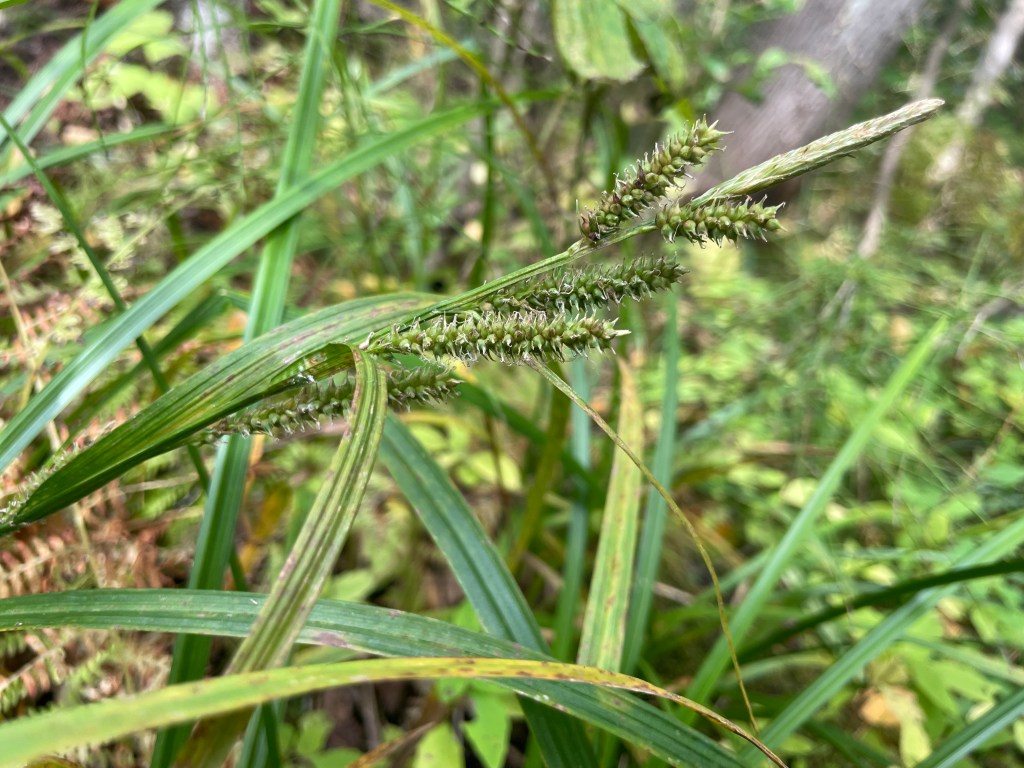
ANPE’s January presentation was given by none other than our own president, Kelly Beaster, who spoke about rare plant species of the Arrowhead region, particularly Duluth and the North Shore. Kelly is a self-employed consulting ecologist who has documented many occurrences of rare plant species in her work, and she was too modest to mention her discovery last year of the first record of Eastern Rough Sedge (Carex scabrata) in Minnesota.
To perform professional rare plant surveys for environmental review of construction projects in Minnesota or Wisconsin people must be tested and certified by the state DNR. Kelly is certified in both states, but she emphasized this is not required for reporting rare plant observations. Anyone can contribute to our collective knowledge by teaching yourself about the potential species you may encounter and what to do if you find one. Her presentation was a kick-start for anyone so inclined.
Kelly began with a comparison of the laws protecting rare species in Minnesota and Wisconsin, defining listed species as endangered, threatened, or special concern. Needless to say, without a permit you can’t pick endangered or threatened species or even their seeds without. She said there are over 300 listed species in Wisconsin and, similarly, over 300 in Minnesota, but only a subset of them is found in our region.
Both states maintain websites with summaries of what’s known about every listed species, including descriptions for identification, maps of the counties where they’ve been recorded, the basis for their listing, their habitat, life history, conservation concerns, and the best time to search for them. Most species also have photos. Listed plants can be rare for a variety of reasons, including a requirement for specialized habitat, occurring at the edge of their range, competition from invasive species, and loss of habitat due to development, recreation, or climate change. Sometimes the reason is unknown.
Information about rare species occurrences is useful for land management decisions, conservation programs, environmental review of construction projects, local government planning, and baseline knowledge about their ecology.
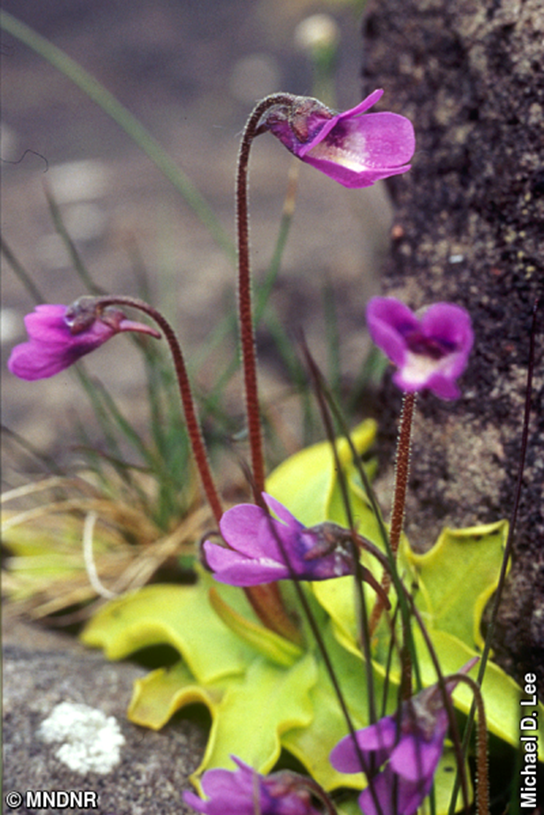
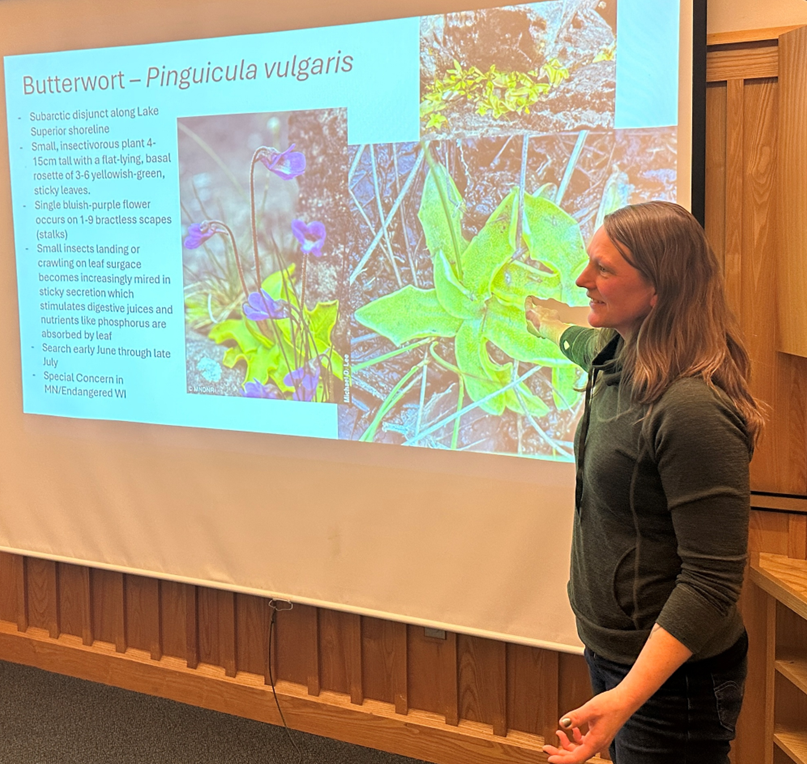
Kelly gave us brief introductions to many rare plants you may find in our region. Some were from the specialized microclimate of the rocky Lake Superior shoreline, including butterwort (Pinguicula vulgaris), which this group saw on a field trip to Two Harbors. Others, like pale sedge (Carex pallescens), often grow in disturbed habitats like mowed forest trails.
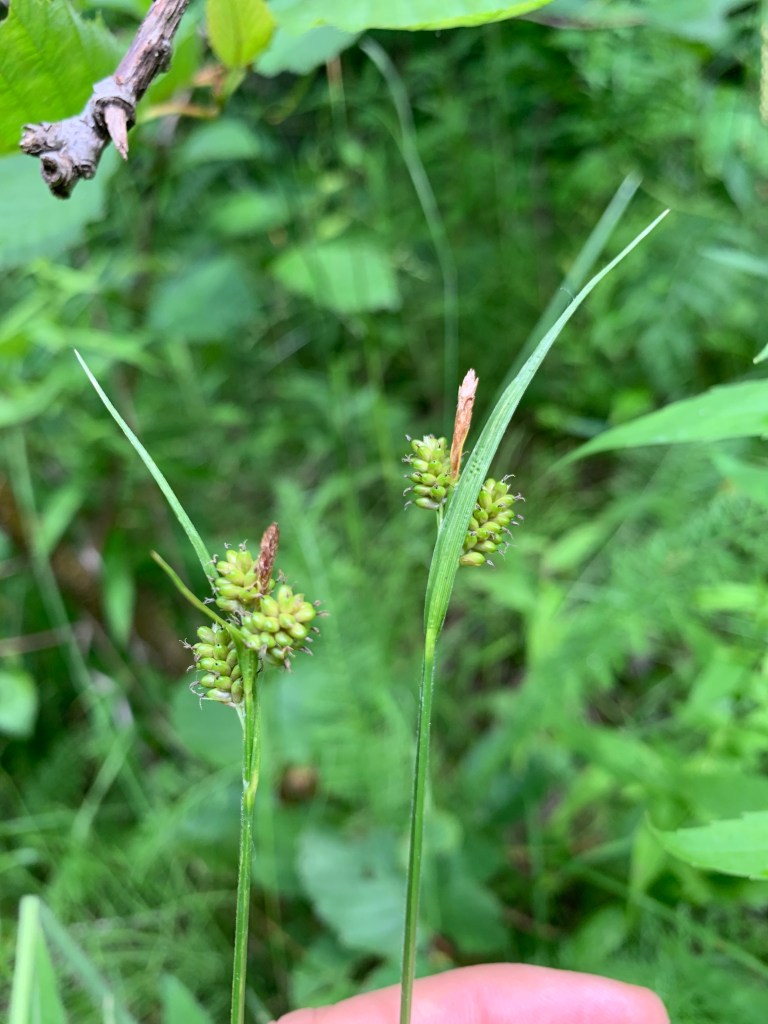
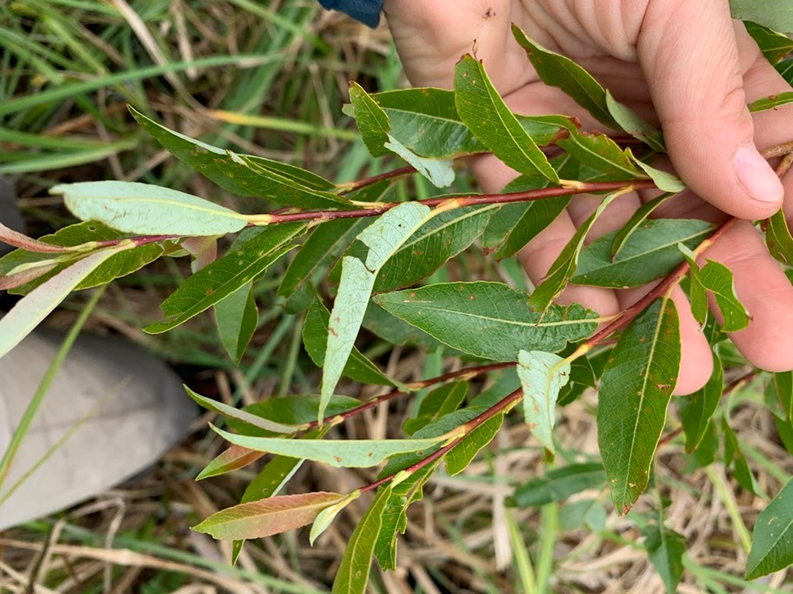
Another rare species we saw on a field trip was beachgrass (Ammophila brevigulata), which is so abundant on Minnesota Point that some may be surprised to learn it’s listed as threatened (but not in Wisconsin). This is the only population in Minnesota, and in some places it is being displaced by a different variety from Michigan. Conversely, plane-leaf willow (Salix planifolia) is fairly common in Minnesota, but listed as threatened in Wisconsin, so when finding it in the St. Louis River estuary, Kelly must determine which side of the state line it is.
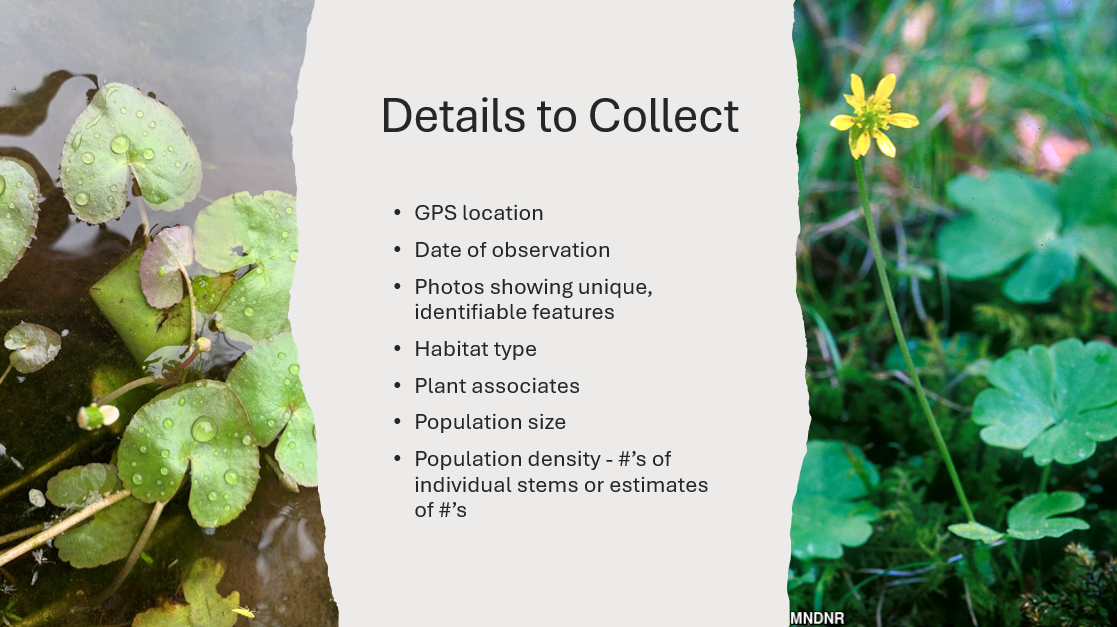
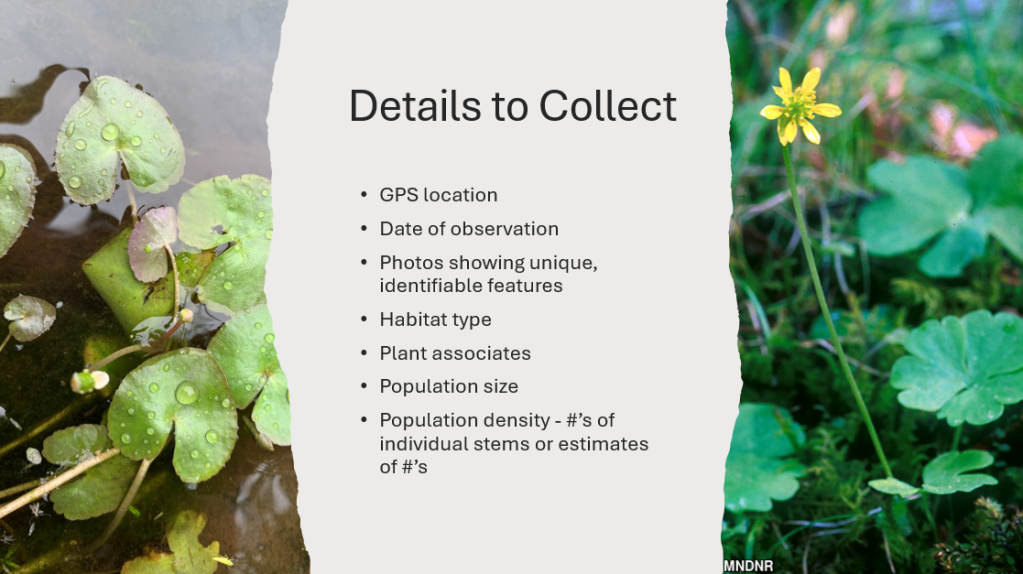
Both states have a process for reporting observations of rare species. For Minnesota it’s by emailing a spreadsheet with data filled in; Wisconsin has an online form. The information you provide should include name of the observer, the date of the observation, gps or other location information, a description of population size, a habitat description, and a list of other plant species growing with it. Observations can also be reported to iNaturalist, but the locations of listed species should be obscured.
Both states also have volunteer rare plant monitoring programs you can join, but in Minnesota at least, there is a long waiting list. For her presentation Kelly drew from the following websites, and these are great places to start for anyone wanting to start keeping an eye out for rare plants.
- Minnesota Wildflowers – Minnesotawildflowers.info
- MN Rare Species Guide – https://www.dnr.state.mn.us/rsg/
- Wisconsin Natural Heritage Inventory Working List –https://apps.dnr.wi.gov/biodiversity/Home/index/plants
- MN Natural Heritage Information System – https://www.dnr.state.mn.us/nhnrp/nhis.html
- Wisconsin Rare Plant Monitoring Program – https://wiatri.net/inventory/rareplants/
 Arrowhead Native Plant Explorers