Written by: Kelly Beaster
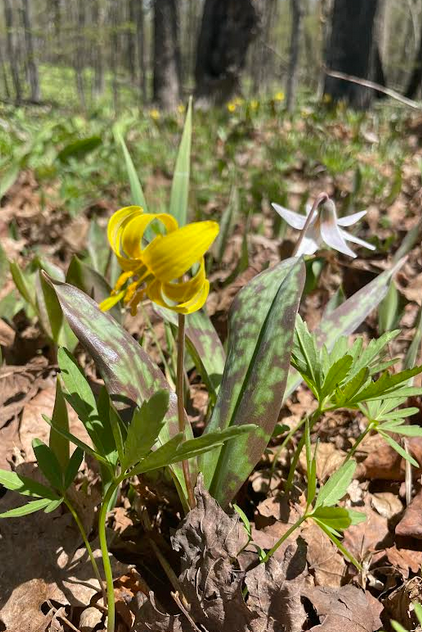
As a dry, hot wind pushed at the ANPE members in Jay Cooke State Park, they all paused to listen to a brief story of how the rabbit lost its tail. Some members swayed in the strong breeze like the blooms of the yellow trout lily bobbing and their shimmering leaves waved with irregular maroon patches giving the impression of shadows floating across the wall. It turns out the rabbit lost its tail as a lesson for all the woodland creatures to learn the importance of resource sharing.
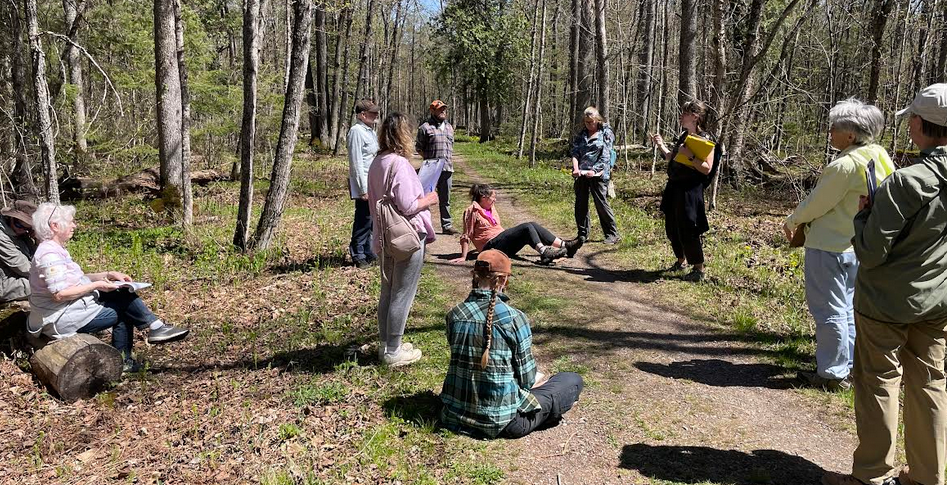
In our fast paced lives, we often use nature to slow down and reconnect. But we can easily become distracted by capturing the perfect angle for a photograph or posting the most species to Inatuarlist or even just getting a workout on the trail. For the annual Spring Ephemerals hike in Jay Cooke State Park, ANPE members and the Voyageurs Conservancy journeyed down the familiar path lined with wildflowers with a new objective – to view this well known place through a new lens. To encourage us to better observe the details, Lake Superior College Writing Teacher, Lindsy O’Brien, led us through several simple writing prompts at various stops along the path. ANPE members spread out to examine and describe the textures, smells, sounds, and even tastes (!) of the intact mesic hardwood forest.
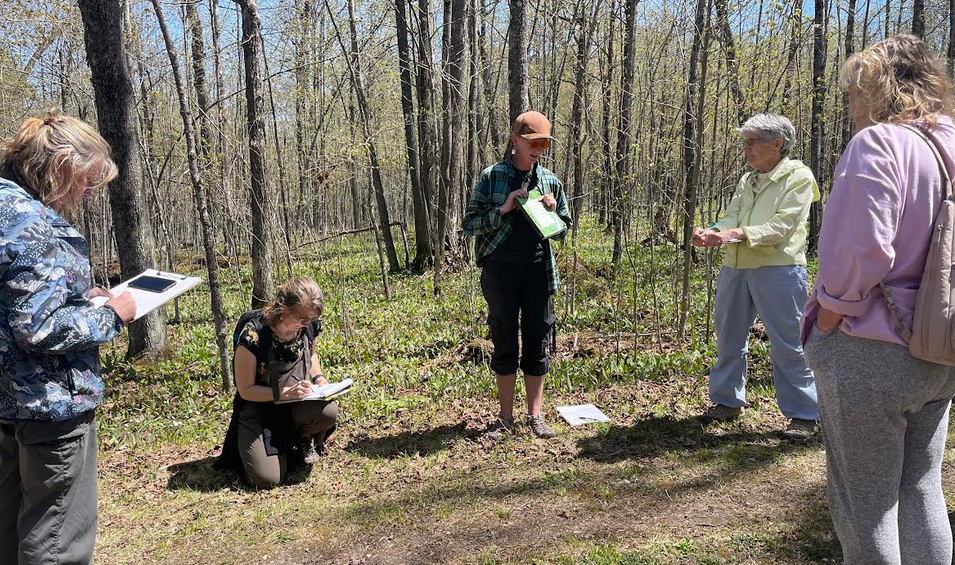
Along the way, Moss Kupper of the Voyageurs Conservancy shared some short readings from the book, Plants Have So Much To Give Us, All We Have To Do Is Ask, Anishinaabe Botanical Teachings, and some guiding principles for harvest from Robin Wall Kimmerer’s book, Braiding Sweetgrass.
Facts were shared along the walks in between writing prompts about the unique spring ephemerals, including pollination techniques, seed dispersal, and resource sharing as members crunched down the gravel footpath.
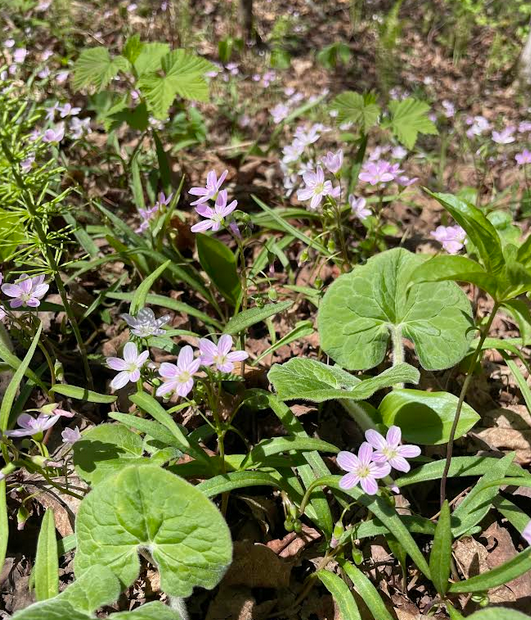
Another highlight was reaching the moschatel (Adoxa moschatellina) under the steadfast cedar near the river. This tiny spring ephemeral inhabits intact mesic hardwood forests that are free of disturbance for long periods of time. Once listed as special concern in Minnesota, it was delisted in 2013 when more populations were discovered during its brief window of activity before it becomes dormant again in its bed of rich soil.
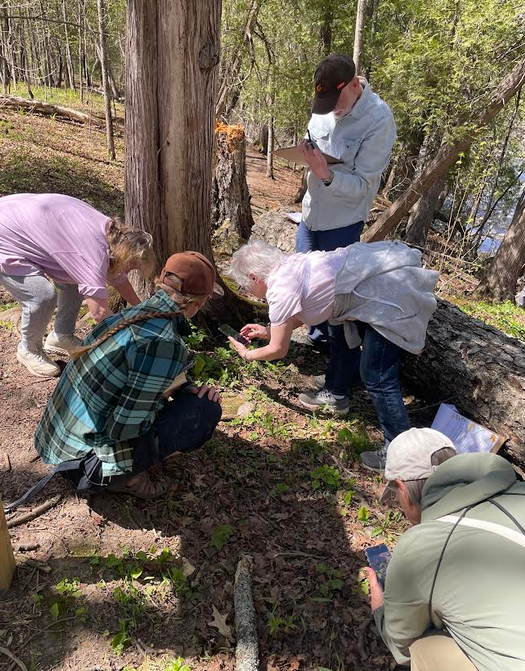
Perhaps that was the lesson threaded throughout the afternoon beneath the budding canopy — not simply to identify more species or record more observations, but to practice attention. The spring ephemerals had already been sharing their brief abundance long before we arrived: trout lilies following the sunlight, ramps pushing through rich soil, and moschatel quietly persisting in forests that have remained connected and undisturbed for generations. For a few windy hours along the St. Louis River, the trail became more than a path to reach the abundant wildflowers. It became an invitation to slow down enough to notice what the forest has been offering all along.
Below are some resources from the hike:
Voyageurs Conservancy Upcoming Events
Lindsy O’Brien’s Writing Prompts
ANPE Spring Ephemerals Handout
Robin Wall Kimmerer’s book, Braiding Sweetgrass
Mary Siisip Geniusz’s book, Plants Have So Much to Give Us, All We Have to Do Is Ask: Anishinaabe Botanical Teachings
Flowering Plants:
White Trout Lily (Erythronium albidum)
Yellow Trout Lily (Erythronium americanum)
Cut-leaved Toothwort (Cardamine concatenata)
Wild Leeks (Allium tricoccum) (not blooming yet)
Virginia Spring Beauty (Claytonia virginica)
Bloodroot (Sanguinaria canadensis) (done blooming)
Wild Ginger (Asarum canadense)
Large-flowered Bellwort (Uvularia grandiflora)
Sessile-leaved Bellwort (Uvularia sessilifolia)
Large-flowered Trillium (Trillium grandiflora)
Marsh Marigold (Caltha palustris)
Wood Anemone (Anemone quinquefolia)
Round-lobed Hepatica (Anemone americana)
Violet (unknown, maybe labradorica)
Hairy Woodrush (Luzula acuminata)
Leatherwood (Dirca palustris)
 Arrowhead Native Plant Explorers