Written by: Joe Walewski
Date: September 19, 2026 • Post No. 3916 • Site: Sax-Zim Bog Welcome Center • Atmosphere: 51°F low, 66°F high.
I started “Field Notes” in 2016 on a simple premise: the wild must be lived to be understood. For a decade, I’ve documented this naturalist’s life to prove that nature isn’t just “out there” – this is a relationship meant to be personal, profound, and lived every day.
– – – – – – –
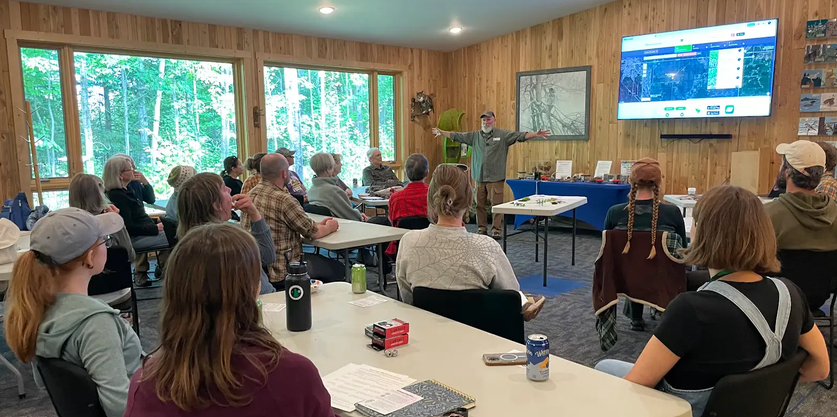
I think it was way back in April when Kelly of the Arrowhead Native Plant Explorers invited me to lead a walk exploring the miniature forest carpeted around the Sax-Zim Bog Welcome Center. It is an ideal classroom; the entire bog ecosystem is built upon the foundational sponginess of Sphagnum moss.
Entering the world of mosses requires us to unlearn human velocity. I often joke that I can botanize trees and flowers from a car window at 55 mph, but bryophytes demand that we drop down low, sink to our knees, and bring our eyes within inches of the damp ground. Slow and low. At 10x magnification through a hand lens, a tiny, overlooked green patch suddenly transforms into an intricate, ancient forest.
Expecting a small handful of five or six curious souls, I was astounded when twenty-five people gathered at the Welcome Center. In a hyper-fast world, twenty-five adult learners chose to pause their daily routines to spend an afternoon “mossing around.” Astounding and heartwarming! Before stepping outside, we agreed to set aside rigid classroom expectations and embrace a shared mindset: everybody has something to give, and everybody has something to gain. We would learn in community.
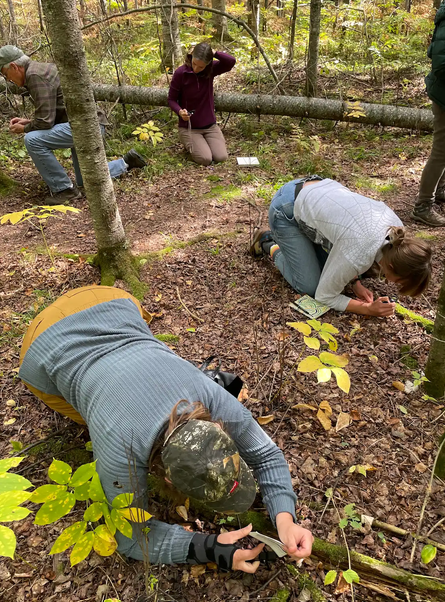
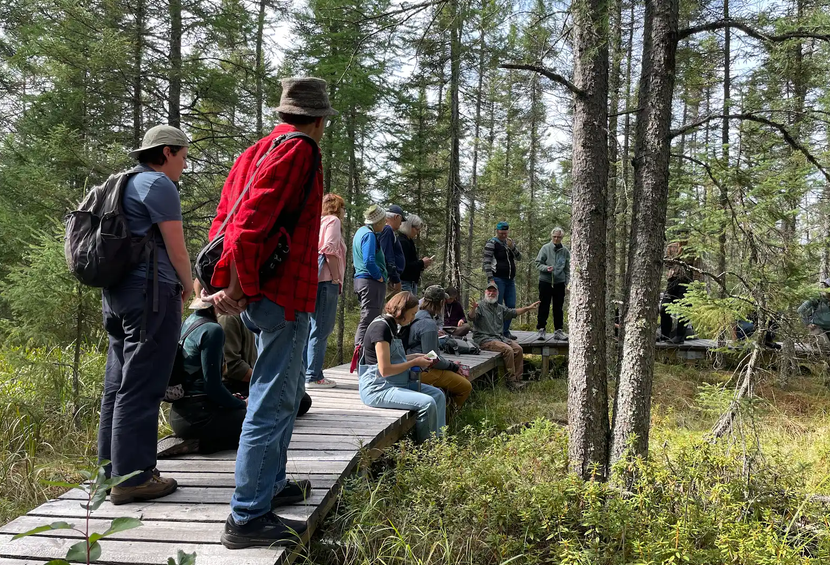
That community carried the day. Together, we noticed 26 species of mosses and liverworts (click here to see the iNaturalist observations) on a very brief walk. Between examining delicate leaf cell structures, we paused to taste ripe cranberries and the crisp wintergreen of Creeping Snowberry leaves. One of our quiet highlights arrived when Adam spotted a small colony of Leathery Grapefern (Sceptridium multifidum), a delicate relative of the moonworts whose unusual, fleshy fronds usually go unnoticed by passing hikers.
 |
| Ostrich-plume Moss (example of a pleurocarp) |
 |
| Red-stemmed Feather Moss (example of a pleurocarp) |
 |
| Wavy Smoothcap Moss (example of a acrocarp) |
 |
| Haircap Moss (example of a acrocarp) |
 |
| Brown Peat Moss (example of a Sphagnum moss) |
 |
| Divine Peat Moss (example of a Sphagnum moss) |
 |
| Ear-leaved Scalewort (example of a leafy liverwort) |
 |
| Tree Fringewort (example of a leafy liverwort) |
The afternoon wrapped up with our group loosely lingering in the parking lot under the late sun. Looking out at the sea of smiling faces – nearly everyone staying until the very end – I felt a quiet gratitude. The magic didn’t belong to any single teacher; the magic emerged from a shared willingness to slow down together, guided by the mosses and liverworts who simply showed up and held the floor.
A Naturalist’s Life is an enchanted affair when we agree to meet the land together on its own quiet, microscopic terms.
 |
| Leathery Grapefern (Sceptridium multifidum) – Adam found this for us!! |
To see more blog posts by Joe, visit his blog: Field Notes – A Naturalist’s Life!
For those who missed the event, here is the Become a Microforest Explorer handout.

